
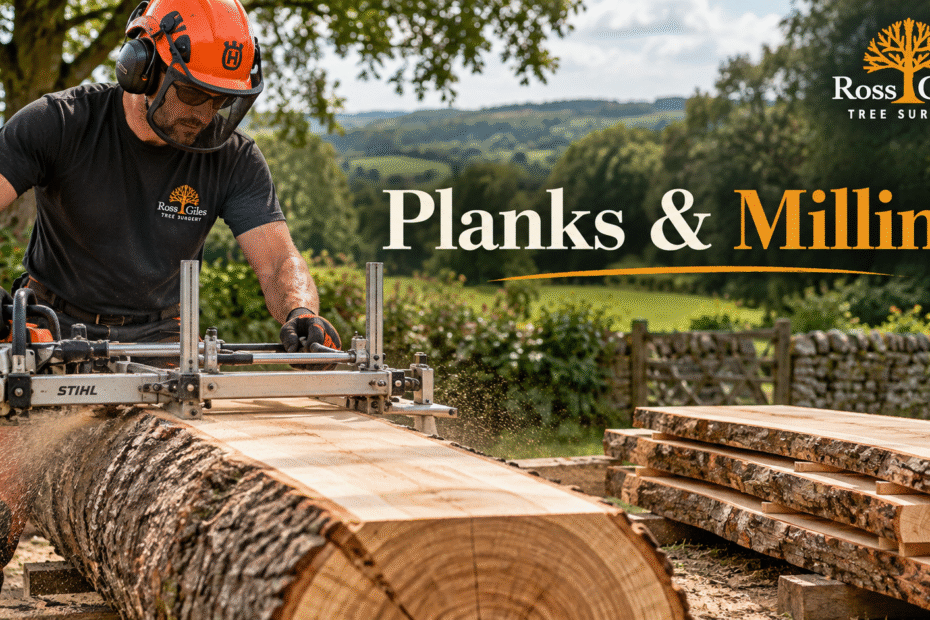
When a large tree has to be felled, the timber does not always need to be treated as waste. With professional planks and milling services, suitable tree trunks can be transformed into practical timber that can be reused for furniture, landscaping features, building projects and many other purposes.
Timber milling is an effective way to make better use of larger sections of felled wood. Instead of cutting a valuable tree trunk into small pieces or removing it for disposal, milling allows the timber to be cut into usable boards, slabs and planks.
Using a chainsaw mill, timber can often be processed directly at the location where the tree has been felled. This is particularly useful on properties where access is limited and bringing in large commercial milling machinery would be difficult or impractical.
What Is Timber Milling?
Timber milling is the process of cutting a tree trunk or large section of timber into boards, slabs or planks of a suitable thickness.
A chainsaw mill uses a specially designed guide system that allows a chainsaw to travel steadily along the timber. This makes it possible to produce relatively consistent timber slabs even when working in gardens, woodland or other areas with restricted vehicle access.
Depending on the size, condition and species of the tree, milled timber can be used for many different purposes.
Common uses include:
- Tables and worktops
- Shelving
- Benches
- Garden furniture
- Timber beams
- Mantelpieces
- Signs
- Decorative timber features
- Landscaping projects
- Woodworking projects
- Bespoke furniture
- Rustic interior features
Milling therefore provides an opportunity to turn what might otherwise be regarded as waste into a valuable and practical natural material.
Making Better Use of Felled Trees
Tree removal is sometimes unavoidable. Trees can become unsafe because of disease, storm damage, structural problems or changes to the surrounding landscape.
However, removing a tree does not necessarily mean that the timber has reached the end of its useful life.
Large trunks may contain substantial quantities of quality timber. Milling these trunks can give the wood a completely new purpose.
A mature tree that has grown for many years may contain attractive grain patterns, natural colouring and characteristics that are difficult to recreate with mass-produced timber.
By milling the trunk into usable planks, these natural features can be preserved and incorporated into future projects.
On-Site Chainsaw Milling
One of the major advantages of chainsaw milling is its flexibility.
Traditional sawmills normally require tree trunks to be transported to a dedicated milling facility. Large trunks can be extremely heavy, making transportation difficult and potentially expensive.
With a portable chainsaw mill, the milling process can often take place where the tree has been felled.
On-site milling may be particularly useful where:
- Vehicle access is restricted
- The tree is located in a rear garden
- Heavy machinery cannot reach the site
- The trunk is too large to transport easily
- The property owner wants to retain the timber
- The timber is intended for a specific future project
Processing the timber on site can reduce unnecessary handling while allowing the owner to see exactly how their tree is being transformed.
What Happens During the Milling Process?
Before milling begins, the trunk needs to be inspected carefully.
Not every piece of timber will be suitable for producing boards. Decay, cavities, metal objects, excessive cracking and structural defects can affect whether a trunk can be safely and successfully milled.
Once a suitable section has been identified, the trunk can be positioned and prepared for cutting.
The first cut creates a level reference surface. Additional passes can then be made to produce boards or slabs at the required thickness.
The exact cutting process will depend on the diameter of the trunk and the intended use of the finished timber.
Thicker slabs may be selected for tables, benches and worktops, while thinner boards may be more suitable for shelving, furniture or woodworking projects.
Upcycling Timber Instead of Wasting It
Upcycling is becoming increasingly important within modern tree work and woodland management.
Rather than automatically treating felled timber as waste, milling creates the opportunity to keep useful natural materials in circulation.
Some timber can remain with the property owner, while other suitable pieces may be removed and processed for future projects.
Upcycled timber can be used to create distinctive products that retain the individual character of the original tree.
Every tree develops differently. Growth rings, knots, grain patterns and colour variations make each piece of milled timber unique.
This means locally milled timber can offer a very different appearance from standard timber products purchased from large retailers.
Sustainable Timber Use
Using timber efficiently can also support a more sustainable approach to tree removal.
Transportation, disposal and the production of new timber products all require resources. Reusing material that is already available can reduce waste and extend the useful life of a felled tree.
Responsible timber use may include:
- Milling suitable trunks
- Producing reusable planks
- Creating furniture or garden features
- Using smaller timber for logs
- Chipping branches for mulch
- Retaining habitat wood where appropriate
- Recycling or repurposing usable material
Not every section of every tree can be reused, but considering these options can significantly reduce the amount of material that needs to be discarded.
Which Trees Can Be Milled?
Many tree species can potentially produce useful timber, although the final result will depend on the individual tree.
Hardwoods are particularly popular because they can offer attractive grain and strong, durable timber.
Species that may be suitable for milling include oak, ash, beech, sycamore, cedar, walnut and several other common trees.
However, species alone does not determine whether a tree is suitable.
The trunk also needs to be assessed for:
- Rot or decay
- Splits
- Cavities
- Significant bends
- Embedded metal
- Previous damage
- Timber quality
- Trunk diameter
- Usable length
A professional assessment can help determine whether milling is worthwhile before work begins.
What Happens After Timber Has Been Milled?
Freshly milled timber contains a significant amount of moisture. For many woodworking applications, it cannot normally be used immediately.
The timber needs time to dry gradually.
Boards are usually stacked with small spacers between each layer. These spacers allow air to circulate around the timber and encourage more even drying.
Correct storage is important because timber can move, twist or split as moisture leaves the wood.
Drying times vary considerably depending on the timber species, board thickness, storage conditions and intended use.
For some projects, timber may need to dry for a considerable period before it is ready for final cutting, sanding or finishing.
Creating Something Unique From Your Own Tree
One of the most interesting aspects of timber milling is the opportunity to preserve part of a tree that may have been growing on a property for decades.
Instead of completely losing the tree when it is removed, sections of timber can potentially become something permanent.
For example, timber from a garden tree could eventually become:
- A dining table
- Outdoor seating
- A coffee table
- Shelving
- A garden bench
- A mantelpiece
- Decorative wall panels
- A memorial piece
- Bespoke furniture
For property owners who have an emotional or historical connection with a particular tree, this can provide a meaningful way to preserve part of it.
Professional Planks & Milling Services
Successful timber milling requires more than simply cutting through a tree trunk.
Understanding how timber behaves, selecting suitable sections and making controlled cuts are all important parts of the process.
Professional milling can help maximise the usable timber obtained from a felled tree while reducing unnecessary waste.
Where access allows, timber can be transported away for further processing. Where access is restricted, portable chainsaw milling can often provide a practical alternative.
Give Felled Timber a Second Life
Large tree trunks can contain valuable timber that deserves more consideration before being removed or discarded.
With planks and milling, suitable felled trees can be transformed into useful boards and slabs that may continue to serve a purpose for many years.
Whether the timber becomes furniture, shelving, landscaping features or another bespoke product, milling provides an excellent opportunity to reuse a natural resource.
If you have a large tree being removed and believe the trunk could be suitable for milling, it is worth discussing the options before the timber is cut into smaller sections.
With careful planning and professional chainsaw milling, a felled tree can become the starting point for an entirely new project rather than simply becoming waste.

