
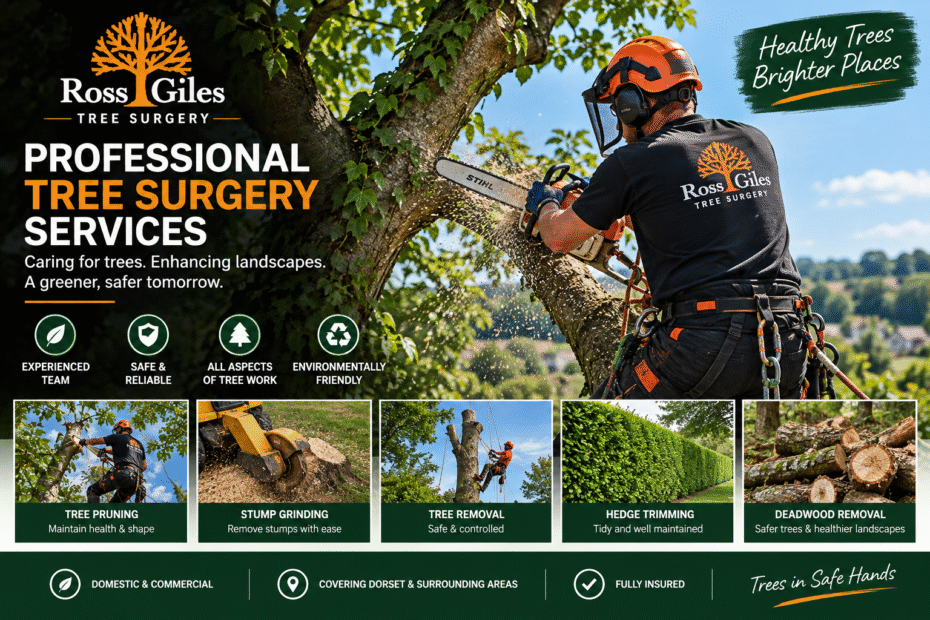
Mature trees are an important feature of gardens, commercial grounds and public spaces, providing character, shade and valuable habitats for wildlife. However, as trees develop and age, dead branches can naturally appear within the canopy, while dense foliage may reduce the amount of light reaching the areas below.
If you are noticing large dead branches falling from a tree, even during calm weather, or would like more light to pass through the canopy without significantly changing the tree’s height and natural shape, professional tree management may be required.
Two commonly used arboricultural techniques are deadwood removal and crown thinning. Although they have different purposes, both involve carefully selected pruning rather than unnecessary removal of healthy branches.
Why Do Trees Develop Deadwood?
The presence of some deadwood within a mature tree is not automatically a sign that the tree is unhealthy.
Branch dieback and shedding can occur naturally as trees grow and age. A tree continually adapts its structure, and branches that no longer contribute effectively to the canopy may eventually die.
However, dead branches can also develop for other reasons, including:
- Natural ageing
- Disease
- Storm or wind damage
- Animal activity
- Insufficient light
- Competition within a dense canopy
- Physical damage to branches
- Changes in growing conditions
The reason for deadwood should be considered alongside the tree’s overall condition.
Is Deadwood Dangerous?
Not every dead branch presents the same level of risk.
A small dead branch positioned away from people and property may require a very different approach from a large branch extending above a driveway, building or frequently used footpath.
Once a branch has died, its condition can gradually deteriorate. Eventually, it may break away from the tree.
Professional deadwood removal may therefore be appropriate where falling branches could present an unacceptable risk to people or surrounding property.
Particular attention may be required when dead branches are positioned above:
- Houses
- Garages
- Driveways
- Footpaths
- Roads
- Car parks
- Play areas
- Garden seating areas
- Frequently used outdoor spaces
A professional assessment can help determine whether removal is necessary.
Why Are Branches Falling on Calm Days?
People often associate falling branches with strong winds and storms. However, branches can sometimes fall when weather conditions appear completely calm.
Where a branch is already dead, weakened or deteriorating, it may eventually reach the point where it can no longer remain attached.
This is one reason why repeatedly finding larger branches beneath a mature tree should not simply be ignored.
It does not automatically mean that the entire tree is dangerous, but an inspection by an experienced arborist can help identify the condition of the canopy and whether appropriate tree work is required.
What Is Deadwood Removal?
Deadwood removal, sometimes called deadwooding, involves selectively removing dead branches from the tree’s canopy.
The objective is not to unnecessarily reshape or reduce a healthy tree. Instead, attention is concentrated on dead material that has been identified for removal.
Professional deadwooding may help:
- Reduce risks associated with falling branches
- Remove problematic dead limbs
- Improve management around buildings and paths
- Maintain safer access beneath trees
- Improve the visual appearance of the canopy
- Allow the remaining healthy structure to be retained
The extent of the work should always be appropriate to the individual tree and its surroundings.
Deadwood Is Also Valuable for Wildlife
Although dead branches can sometimes present a safety concern, deadwood is an important part of the natural environment.
Dead and decaying wood can provide habitat, food and shelter for numerous organisms. Insects, fungi and other wildlife can all benefit from deadwood, and cavities within older trees may provide valuable shelter.
This creates an important balance for tree management.
Removing every piece of deadwood simply because it is dead is not necessarily appropriate. Where deadwood does not present an unacceptable risk, retaining suitable material can provide ecological benefits.
Professional arboricultural management considers both safety and biodiversity rather than treating them as completely separate issues.
What Is Crown Thinning?
Crown thinning is a selective pruning technique used to reduce the density of foliage and smaller branches throughout a tree’s crown.
Unlike crown reduction, the primary aim is not to significantly reduce the overall height or spread of the tree.
Instead, selected growth is removed throughout the canopy while maintaining a balanced structure.
A properly completed crown thin should retain an even distribution of foliage rather than creating obvious gaps or removing excessive growth from individual areas.
Why Is Crown Thinning Carried Out?
One of the main reasons for crown thinning is to increase light penetration through a dense canopy.
A large tree can create substantial shade when its foliage becomes particularly dense. Selective thinning can allow additional light through while retaining much of the tree’s existing size and natural outline.
Potential reasons for considering tree crown thinning include:
- Increasing light through the canopy
- Maintaining the tree’s overall height
- Retaining its natural shape
- Improving canopy structure
- Removing selected crossing or problematic branches
- Creating a more balanced distribution of foliage
The amount of foliage removed needs to be carefully controlled.
More Light Without Losing the Tree’s Height
Homeowners sometimes assume that reducing a tree’s height is the only way to allow more sunlight into a garden.
That is not always the case.
Where appropriate, crown thinning can increase light penetration without substantially changing the overall dimensions of the tree.
This can be particularly useful when the tree itself is an attractive feature and the homeowner wants to preserve its mature appearance.
Rather than dramatically cutting back the outer canopy, an arborist selectively works within the crown to achieve a more open structure.
Maintaining the Natural Shape of the Tree
Good tree surgery should consider the natural form of the individual tree.
Poorly planned pruning can leave a canopy looking uneven, sparse or artificially shaped. Excessive branch removal can also create unnecessary stress for the tree.
Professional crown thinning should aim for an even density of foliage across a well-spaced and balanced branch structure.
Key objectives include:
- Maintaining overall shape
- Avoiding large empty sections
- Retaining suitable healthy branches
- Creating balanced foliage density
- Avoiding unnecessary pruning
- Considering future tree development
When completed appropriately, the work should appear relatively subtle.
Crown Thinning Is Not Crown Reduction
Crown thinning and crown reduction are different arboricultural techniques.
A crown reduction involves reducing the overall dimensions of a tree’s canopy, usually by carefully shortening selected branches throughout the outer crown.
Crown thinning, by comparison, concentrates on foliage density while generally maintaining the tree’s existing overall dimensions.
In simple terms:
- Crown thinning reduces canopy density.
- Crown reduction reduces canopy size.
- Crown lifting increases clearance beneath the canopy.
- Deadwood removal targets dead branches.
The appropriate technique depends on the reason for carrying out the tree work.
How Much Foliage Should Be Removed?
Crown thinning does not mean removing as much internal growth as possible.
The amount of foliage removed should be carefully considered according to the tree’s species, age, condition and structure.
Excessive pruning can unnecessarily affect the tree and may create an unnatural appearance.
Professional arborists aim to retain a balanced canopy with an appropriate amount of live foliage.
This is why crown thinning should be based on an assessment of the individual tree rather than applying the same percentage or pruning pattern to every specimen.
Creating a Balanced Branch Structure
The quality of crown thinning depends heavily on which branches are selected.
Simply removing branches randomly from the centre of the canopy will not necessarily produce a good result.
An experienced arborist considers how each selected cut contributes to the overall structure.
Attention may be given to:
- Branch spacing
- Foliage distribution
- Crossing branches
- Damaged growth
- Dead branches
- Overall canopy balance
- Natural tree form
- Future growth
The objective is a well-spaced structure that remains visually balanced.
Can Crown Thinning Help Prepare for Future Tree Management?
A well-managed branch structure can make future tree maintenance more straightforward.
Where appropriate, selective pruning may help establish a balanced framework that can be considered during future management, including potential crown reduction where this later becomes necessary.
Tree management should ideally consider long-term development rather than focusing solely on how the tree looks immediately after pruning.
Regular professional assessment can help identify changing requirements as a mature tree continues to grow.
Crown Thinning for Residential Gardens
Large established trees can be wonderful features within residential gardens, but dense crowns can sometimes restrict natural light.
This may affect patios, lawns, windows and other parts of the garden.
Where the tree is suitable for the work, crown thinning services may provide an alternative to dramatically reducing its overall size.
Homeowners may benefit from:
- Improved light penetration
- Retention of a mature tree
- Preservation of natural height and shape
- A more balanced canopy
- Professional removal of selected branches
Every tree should be individually assessed before pruning is recommended.
Deadwood Above Gardens and Outdoor Areas
Dead branches deserve particular attention when they are positioned above areas where people regularly spend time.
A garden may contain seating areas, children’s play spaces, sheds, greenhouses and other features beneath established trees.
Where substantial dead branches are present, the location of these features can influence the level of concern.
An arborist can inspect the canopy and determine whether selective deadwood removal would be appropriate while retaining ecologically valuable material where reasonably possible.
Trees Near Roads and Footpaths
Trees positioned beside roads and pedestrian routes require careful management because branches may extend over areas that are regularly used.
Deadwood in these locations can have different implications from deadwood in an isolated part of a large woodland or private site.
Professional assessment should consider:
- Branch size
- Branch condition
- Position within the canopy
- Traffic beneath the tree
- Pedestrian activity
- Nearby buildings
- Surrounding property
The aim is proportionate management based on the tree and its environment.
The Importance of Professional Tree Assessment
It can be difficult to assess a mature tree accurately from ground level.
Dead branches may be partially hidden by foliage, while other problems can be difficult for an untrained person to recognise.
A professional arborist can assess the tree’s canopy and determine what type of work, if any, is appropriate.
An assessment may consider:
- Overall tree condition
- Quantity and position of deadwood
- Branch structure
- Previous pruning
- Canopy density
- Surrounding property
- Public access
- Wildlife considerations
This helps ensure that recommendations are based on the actual condition of the tree.
Avoiding Unnecessary Tree Pruning
More pruning does not automatically mean better tree management.
Removing excessive healthy growth can alter the tree’s natural structure and appearance.
Good arboriculture is often about carrying out only the work that is necessary to achieve a clear objective.
Whether the aim is crown thinning, deadwood removal or another form of tree management, careful branch selection is essential.
A measured approach helps preserve the character of mature trees while addressing practical concerns.
When Should You Contact a Tree Surgeon?
Professional advice may be worthwhile if you notice significant changes in a tree or have concerns about its branches.
Consider arranging an assessment if:
- Large branches are regularly falling
- Dead branches are visible above property
- Branches overhang busy areas
- The canopy has become extremely dense
- You want more light beneath the tree
- You want to retain the tree’s existing height
- The tree has suffered storm damage
- You are concerned about unusual dieback
An assessment can determine whether tree surgery is required and which technique is appropriate.
Why Experienced Arborists Matter
Working on mature trees can involve height, heavy branches and complex structures.
Tree surgery therefore requires appropriate skills, equipment and knowledge.
Experienced arborists understand that each pruning decision can affect the remaining tree.
Professional tree work offers several advantages:
- Appropriate assessment
- Careful branch selection
- Specialist equipment
- Consideration of tree structure
- Knowledge of pruning techniques
- Attention to surrounding property
- Consideration of wildlife
- A balanced finished appearance
This expertise becomes particularly important when working on larger mature trees.
Balancing Safety, Tree Health and Biodiversity
Effective tree management is rarely about one consideration alone.
Deadwood may provide valuable wildlife habitat while simultaneously presenting a concern if positioned above a heavily used area. A dense canopy may be healthy but create excessive shade for the property beneath it.
Professional arboriculture seeks an appropriate balance.
Where possible, valuable tree features can be retained while specific risks or practical problems are addressed through carefully targeted work.
This approach can help preserve mature trees rather than resorting to unnecessarily severe pruning.
Professional Crown Thinning and Deadwood Removal
Mature trees naturally change as they grow, and the development of some deadwood is part of that process. However, large dead branches positioned above people or property may require professional assessment and, where appropriate, removal.
Similarly, a dense tree canopy does not necessarily need to be dramatically reduced simply to increase light.
Professional crown thinning can selectively reduce foliage density while maintaining the tree’s overall height, spread and natural shape. When performed correctly, an even distribution of foliage should remain throughout a balanced branch structure.
By combining careful deadwood removal with appropriate crown management, experienced arborists can address practical concerns while respecting the tree’s structure and ecological value.
If you are experiencing large branches falling from a tree, are concerned about deadwood or simply want more light through a dense canopy without losing the character of your tree, a professional arboricultural assessment is the best place to start.

