
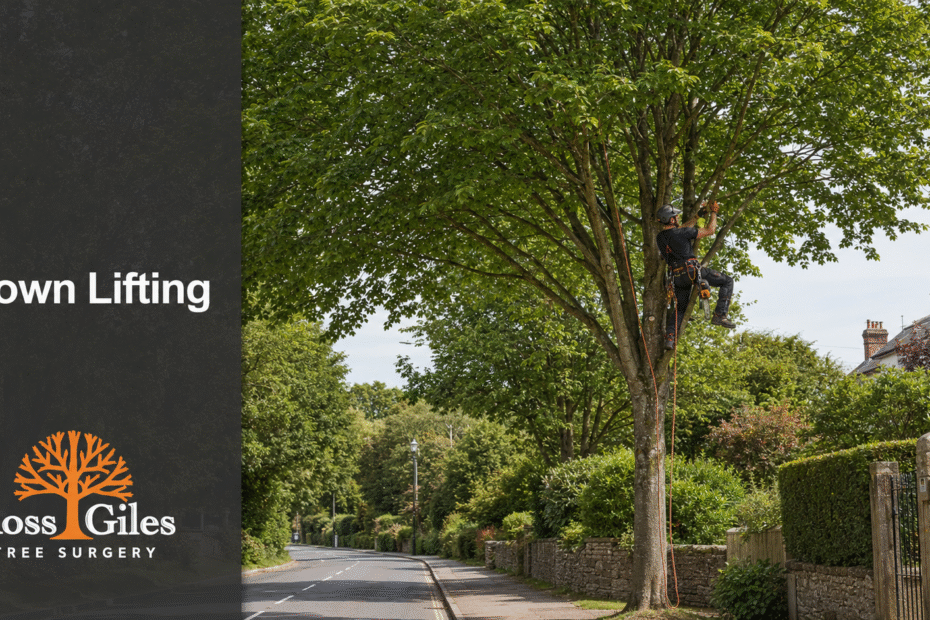
Trees add character, shade and environmental value to gardens, commercial sites and public spaces. However, their lower branches can sometimes create practical problems as the canopy develops. Branches may begin to obstruct a footpath, hang over a highway, restrict access to a driveway or interfere with vehicles and pedestrians.
Crown lifting provides a carefully controlled solution. It involves removing or shortening selected lower branches to increase the vertical distance between ground level and the lowest remaining foliage. When completed professionally, the work improves access and visibility while retaining the tree’s natural appearance and healthy canopy.
What Is Crown Lifting?
Crown lifting, also known as crown raising, is a tree-pruning technique focused on the lower part of the canopy. Selected branches are removed from the main stem or reduced back to suitable growth points to create a specified clearance beneath the tree.
This technique may be used to provide more space above:
- Footpaths and pavements
- Roads and highways
- Driveways and parking areas
- Garden paths and entrances
- Buildings and roofs
- Lawns and landscaped areas
- Construction or development sites
- Signs, lighting and security cameras
The objective is not simply to remove every low branch. A professional arborist considers the tree’s species, age, condition, shape and surroundings before deciding which branches should be pruned.
Why Might a Tree Need Crown Lifting?
As a tree grows, branches that were once well above ground level may begin to extend across areas used by people or vehicles. This can reduce access and increase the risk of accidental damage to both the tree and surrounding property.
Clearing Footpaths
Low branches can force pedestrians to step around the canopy or walk closer to a road. They may be particularly inconvenient for taller pedestrians, wheelchair users, parents with pushchairs and people with impaired vision.
Crown lifting can create a clearer route beneath the tree while preserving sufficient foliage to maintain its appearance and vitality.
Providing Highway Clearance
Branches overhanging a highway can be struck by buses, lorries and other tall vehicles. Repeated impact may tear branches from the canopy, creating poor pruning wounds and increasing the possibility of falling debris.
Carefully lifting the crown provides additional clearance and reduces the risk of damage caused by passing traffic.
Improving Driveway and Site Access
Low growth may restrict the use of a driveway, parking area, gateway or working site. Crown lifting can provide the clearance required for cars, vans, machinery or delivery vehicles without removing the entire tree.
Where access is needed for a building project, the work should be planned carefully to avoid unnecessary pruning or damage to the tree’s roots.
Increasing Light and Visibility
Removing selected lower branches can allow more light beneath the canopy and improve views through a garden or commercial landscape. It may also prevent foliage from obscuring road signs, entrances, lighting and security equipment.
Crown lifting is not intended to thin the whole canopy, but raising its lower edge can make the surrounding space feel more open.
How Much of the Crown Should Be Retained?
Crown lifting should always be subtle and proportionate. As a general arboricultural principle, the remaining live crown should account for at least two-thirds of the tree’s overall height after the work is completed.
Removing too many lower branches can create an unbalanced tree with a small, top-heavy canopy. This may affect its appearance and place additional stress on the remaining structure.
For example, excessive lifting may:
- Reduce the tree’s ability to produce energy
- Create large pruning wounds
- Increase stress and vulnerability
- Alter the natural distribution of weight
- Encourage undesirable growth
- Expose previously sheltered parts of the tree
- Make the trunk appear unnaturally bare
A mature tree may respond poorly to the removal of several large limbs in one visit. Where a significant increase in clearance is required, the work may need to be completed gradually over several pruning cycles.
Why Large Branches Require Special Care
The size of a pruning wound influences how successfully a tree can respond to it. Removing a large branch leaves a substantial exposed area that takes longer to seal naturally and may provide an opportunity for decay to develop.
For this reason, crown lifting is often most effective when planned while a tree is relatively young. Smaller branches can be removed or shortened before they become major structural limbs.
On mature trees, an arborist may recommend reducing the length of a lower branch rather than removing it completely. This can improve clearance while retaining foliage and avoiding an unnecessarily large wound on the main stem.
Every cut should be made in an appropriate position without damaging the branch collar, tearing the bark or leaving an excessive stub.
Crown Lifting Compared with Other Pruning Methods
Different tree-pruning techniques achieve different results. Understanding the distinction helps ensure that the correct work is selected.
Crown Reduction
Crown reduction decreases the overall height or spread of the canopy. It is used when a tree has become too large for its surroundings or when carefully reducing the mechanical load on selected branches.
Crown lifting focuses only on raising the lower edge of the canopy and does not normally reduce the tree’s overall height.
Crown Thinning
Crown thinning involves removing selected branches throughout the canopy to reduce its density. It can improve light penetration and air movement while retaining the tree’s general size and shape.
Crown lifting removes or shortens growth specifically from the lower crown to create vertical clearance.
Deadwood Removal
Deadwood removal targets dead, damaged or declining branches that may fall or affect the tree’s condition. It can be completed independently or alongside crown lifting when necessary.
A professional assessment will determine which pruning method, or combination of methods, is most suitable.
When Is the Best Time for Crown Lifting?
The appropriate time to prune depends on the tree species, its health, the surrounding environment and the amount of work required. Some trees respond well to pruning during their dormant period, while others may require work at a different time to reduce the likelihood of disease or excessive sap loss.
Trees should also be inspected for nesting birds and other wildlife before pruning begins. If an active nest is present, work affecting it may need to be postponed.
The tree may also be protected by a Tree Preservation Order or located within a conservation area. Any necessary permission or notification should be confirmed before work starts. A professional tree surgeon can help identify these considerations and advise on the appropriate process.
How Professional Crown Lifting Is Carried Out
The process begins with an assessment of the tree and the clearance required. The arborist examines its species, health, branch structure and proximity to roads, buildings and other features.
Suitable branches are then selected for removal or reduction. Rather than cutting every branch at the same height, the arborist aims to maintain a natural canopy outline and balanced structure.
Professional equipment and safe working methods are used to access the canopy and control the removed material. This is particularly important when the tree stands beside a highway, building, parked vehicle or public path.
After pruning, branches and debris are cleared from the site, leaving the area safe and tidy.
Why Choose a Professional Tree Surgeon?
Crown lifting requires more judgement than simply cutting away low branches. Poor pruning can leave permanent damage, create an unnatural shape and negatively affect the health or stability of the tree.
A qualified and experienced arborist can:
- Assess whether crown lifting is appropriate
- Identify a suitable level of clearance
- Retain a balanced proportion of live crown
- Avoid unnecessary large pruning wounds
- Use correct cutting techniques
- Consider nearby people, vehicles and property
- Check for visible signs of poor health or structural weakness
- Complete the work using suitable safety equipment
Professional advice is particularly important for mature trees, protected trees and specimens growing close to public highways.
Arrange a Professional Crown-Lifting Service
Crown lifting can provide essential clearance over footpaths, roads, driveways and working areas while allowing a valuable tree to remain in place. The best results are achieved through careful planning, selective pruning and respect for the tree’s natural form.
Whether lower branches are restricting access, obstructing pedestrians or at risk of being struck by vehicles, our experienced tree surgeons can assess the situation and recommend an appropriate solution.
Contact our team today to discuss your crown-lifting requirements and arrange a professional tree assessment. We will complete the work carefully, improve the available clearance and retain as much of the tree’s healthy, balanced canopy as possible.

