
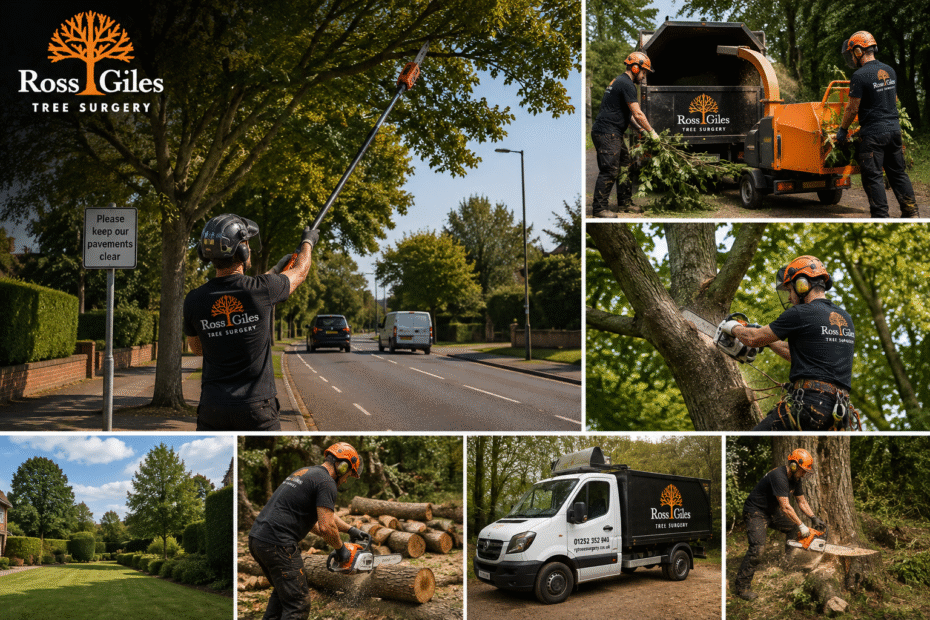
Trees are an important part of our surroundings, but as they mature, lower branches can begin to cause access problems. Branches may overhang a footpath, extend towards a highway or restrict vehicles and machinery from entering a site. In these situations, crown lifting can provide a practical tree management solution.
Crown lifting involves carefully pruning selected lower branches to increase the vertical clearance between ground level and the lowest part of the tree canopy. When carried out correctly, the work should be subtle, retaining the natural appearance and healthy structure of the tree while providing the clearance required.
What Is Crown Lifting?
Crown lifting is a tree pruning technique that focuses specifically on the lower part of the canopy. Selected lower branches are removed or reduced to create additional clear space beneath the tree.
Unlike more extensive forms of tree pruning, the objective is not necessarily to reduce the overall height or spread of the tree. Instead, the work concentrates on raising the height at which the canopy begins.
Crown lifting may be useful where:
- Branches overhang public footpaths
- Lower growth extends towards a highway
- Vehicles require additional clearance
- Site access is being restricted
- Pedestrian movement beneath a tree is difficult
- Lower branches interfere with surrounding areas
The amount of work required will depend on the individual tree, its age, species, condition and location.
Crown Lifting Trees Over Footpaths
Trees positioned close to pavements can gradually extend across pedestrian routes as their branches grow.
Low branches can become inconvenient for pedestrians and may obstruct the usable space beneath the canopy. Appropriate tree crown lifting can increase clearance while allowing the upper canopy to remain largely unaffected.
Rather than unnecessarily removing large sections of the tree, a professional approach focuses on selected lower branches and the amount of clearance actually required.
Crown Lifting Trees Near Highways
Roadside trees require particular consideration because low branches may come into contact with passing vehicles.
Lorries, buses and other tall vehicles can potentially strike branches that extend too far into the highway. Repeated contact may damage the tree and create additional management concerns.
Crown lifting can help provide suitable vertical clearance between the highway and the tree canopy.
Common reasons for carrying out the work include:
- Improving clearance for passing vehicles
- Reducing interference with road users
- Removing problematic low branches
- Protecting branches from vehicle impact
- Maintaining a clearer highway environment
The work should always take account of the health and structure of the tree rather than simply removing every branch below a particular height.
Improving Access to a Site
Low tree branches can also become an issue on private, commercial and development sites.
Vehicles, machinery and equipment may require greater clearance than ordinary pedestrian traffic. Where lower branches prevent suitable access, carefully planned crown lifting may provide the additional space required.
Before pruning begins, it is important to consider both the access requirement and the effect that removing branches could have on the tree.
Why Crown Lifting Should Be Subtle
Good crown lifting should not leave a tree looking unnaturally top-heavy.
Removing too many lower branches can significantly alter the tree’s natural form. This is why crown lifting needs to be carefully planned rather than treated simply as the removal of everything below a chosen level.
As a general principle, sufficient live crown should remain after pruning. Retaining a substantial proportion of the tree’s canopy helps preserve its natural structure and appearance.
The work should aim to achieve the required clearance with appropriate, selective pruning.
The Importance of Retaining a Healthy Crown
The crown contains the branches and foliage that play a fundamental role in the life of a tree. Excessive pruning can therefore be counterproductive.
When crown lifting is undertaken, the relationship between the cleared stem and remaining live crown needs to be considered carefully.
Professional tree work should consider:
- Tree species
- Age and maturity
- Existing branch structure
- Tree health
- Required clearance
- Size of branches being considered for removal
- Surrounding roads, paths and buildings
- The long-term development of the canopy
This assessment helps determine whether crown lifting is appropriate and how much pruning should be undertaken.
Crown Lifting Young and Mature Trees
The approach required can vary considerably depending on the age of the tree.
With younger trees, careful formative pruning may help establish appropriate clearance as the tree develops. Planning ahead can sometimes reduce the need for more substantial branch removal later.
Mature trees require particularly careful consideration. Removing large established branches can have a greater impact than pruning smaller branches earlier in the tree’s development.
For this reason, professional crown lifting should be based on the individual tree rather than applying exactly the same pruning method in every situation.
Crown Lifting Is Different from Crown Reduction
Crown lifting and crown reduction are sometimes confused, but they have different objectives.
Crown lifting concentrates on increasing clearance beneath the lower canopy. Crown reduction generally involves reducing the overall height or spread of a tree’s crown.
The key differences are:
- Crown lifting focuses on lower branches
- Crown reduction affects the overall dimensions of the canopy
- Crown lifting creates vertical clearance underneath
- Crown reduction is used where the overall crown needs appropriate reduction
Understanding the reason for pruning is essential when determining which type of tree work is appropriate.
Crown Lifting Versus Crown Thinning
Crown thinning is another tree management technique with a different purpose.
Thinning involves selectively removing branches throughout the crown to alter its density while generally retaining its overall shape and size.
By comparison, crown lifting a tree concentrates on the lowest branches to provide additional clearance beneath the canopy.
A professional assessment can help establish which technique, or combination of appropriate works, is suitable.
Benefits of Professional Crown Lifting
When appropriate for the tree and carried out correctly, crown lifting can offer several practical advantages:
- Increased clearance above footpaths
- Improved access beneath trees
- Better clearance for vehicles
- Reduced likelihood of low branches being struck
- Improved access to commercial or development sites
- Retention of much of the existing canopy
- A cleaner space beneath the tree
- More practical management of roadside trees
The objective should always be to achieve these benefits without carrying out unnecessary pruning.
Planning Tree Work Carefully
Before any substantial pruning is undertaken, the tree and its surroundings should be assessed.
The required clearance may differ considerably between a garden path, public pavement, driveway and highway. The location can therefore influence how the work needs to be approached.
A tree professional may need to consider:
- Current canopy height
- Location of problematic branches
- Nearby roads and footpaths
- Vehicle access requirements
- Pedestrian access
- Tree condition
- Potential future growth
- Any relevant restrictions or permissions
Careful planning helps ensure that the proposed work addresses the actual problem.
Do You Need Crown Lifting?
You may want to consider professional advice if a tree is beginning to interfere with normal access around your property or site.
Typical warning signs include:
- People having to duck beneath branches
- Branches extending across a pavement
- Larger vehicles struggling to pass safely
- Site machinery being obstructed
- Lower branches regularly being struck
- Driveway access becoming restricted
These signs do not automatically mean that substantial branches need to be removed. An assessment can determine the most appropriate pruning approach.
Professional Crown Lifting for Better Clearance
Trees and access routes can coexist successfully when their growth is managed appropriately. Where lower branches begin to obstruct highways, footpaths, driveways or site entrances, crown lifting can provide a targeted solution without unnecessarily reducing the entire canopy.
The key is careful, selective pruning. The required vertical clearance should be achieved while retaining an appropriate proportion of healthy live crown and preserving the tree’s natural form wherever possible.
If your tree is overhanging a footpath or highway, or lower branches are restricting access to a site, professional crown lifting can help create the necessary clearance while ensuring the work is planned around the long-term condition and structure of the tree.

